



What Should You Look for in a Dash Cam? A Practical Guide for UK Drivers
A dash cam can spend most of its life doing something remarkably unexciting: quietly recording the road ahead.
That's rather the point.
You may never need the footage however, if you're involved in an accident; have a dispute about what happened or simply want a clear record of an incident, having that camera already recording can be extremely useful.
The tricky part is always going to be choosing the right one. There are now plenty of dash cams available, with different resolutions, camera arrangements and features. So what actually matters when you're choosing one for everyday driving?
Start with the quality of the footage
The most important job of a dash cam is to record what's happening on the road clearly.
Resolution is part of that, but it isn't the whole story. Good footage also depends on the camera's sensor, lens and how it handles different lighting conditions.
Make sure you think about these situations in which you might actually need that recording. A camera that produces clear footage in daylight but struggles when it's dark isn't particularly useful if an incident happens on a winter evening.
It's also worth thinking about the detail. Being able to make out a vehicle's number plate or other important information can make a significant difference when reviewing footage.
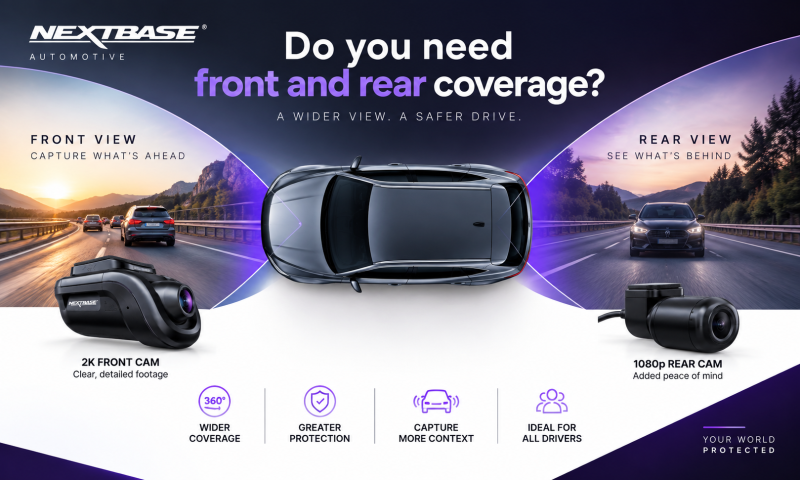
Do you need front and rear coverage?
A basic dash cam records the road ahead and that’s enough for many drivers, particularly if the main reason for buying one is to have a record of what's happening in front of the vehicle.
Having said that, a front-and-rear setup will give you a much wider view of what is happening around the car. That can be particularly appealing if you want greater coverage rather than simply recording the road ahead.
There isn't necessarily a right answer for everyone so consider how much coverage you want and how much extra equipment you're comfortable having fitted to the vehicle.
Don't overlook parking protection
Some dash cams can also provide protection while your car is parked, but the way this works varies between models.
Parking functionality can be worth considering if you regularly leave your car in public car parks, on the street or elsewhere unattended. Depending on the system, the camera may be able to detect an impact or movement and record an event while the vehicle is parked.
There is an important practical point here: parking features can have different power requirements, so check exactly how the system works before buying. Some setups use a hardwire kit rather than simply relying on the car's normal power socket.
Which features are actually useful?
Dash cams now offer considerably more than simply pressing record.
GPS
GPS can add location information to recordings. Depending on the camera, other information may also be associated with the footage.
For some drivers that's useful; for others, it may not be particularly important. It comes down to what you want from your camera.
Wi-Fi and smartphone connectivity
Obviously, being able to connect to a dash cam to a smartphone can make reviewing or transferring recordings much easier to do.
This is particularly useful if you ever need to find a particular clip rather than removing the memory card and transferring files using a computer.
Loop recording
Most dash cams are designed to record continuously rather than requiring you to manually delete old footage however, with loop recording, older unprotected files can be overwritten as the storage fills up which allows the camera to continue recording without constant attention.
Storage
Don't forget about the memory card.
A dash cam needs somewhere to store its recordings, and the type and capacity of card supported will depend on the camera. It's worth checking the manufacturer's requirements rather than assuming any microSD card will be suitable.
Think about installation before you buy
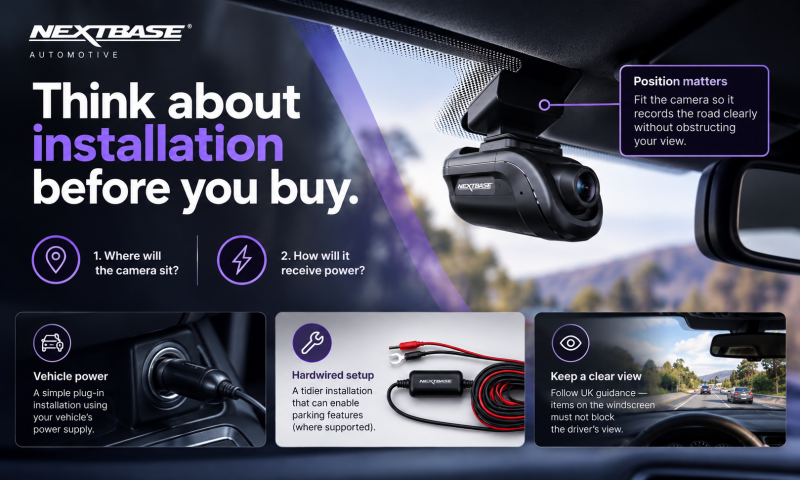
There are generally two things to consider here:
- Where will the camera sit
- How it will receive power
A straightforward installation can use the vehicle's power supply, while a hardwired setup can provide a tidier installation and, where supported by the camera, enable features that operate while the vehicle is parked.
If you're considering hardwiring, check what is compatible with the particular dash cam and vehicle before buying.
The physical position of the camera will matter too. It should be positioned so that it records the road effectively without becoming an obstruction.
UK guidance requires drivers to have a clear view of the road ahead, and items placed on a windscreen must not block the driver's view.
So, which type of dash cam should you choose?
It really depends on what you want the camera to do.
If you want straightforward recording: prioritise good-quality footage and simple operation.
If you want more coverage: look at front-and-rear systems.
If your car spends a lot of time parked in public: investigate parking protection and how the camera is powered when the engine is off.
If you want easy access to recordings: look for a model with suitable smartphone connectivity.
If you want more information attached to your footage: GPS may be worth considering.
The most expensive camera isn't automatically the right camera for you. The useful features are the ones that match how you actually use your car.
Nextbase dash cams at Close Motor Company
Close Motor Company now offers Nextbase dash cams as part of its range of automotive products.
Nextbase currently offers dash cams across a range of specifications and use cases, from straightforward cameras through to more advanced connected systems. Its current range includes the 385GW and 385GWX, which we offer, as this is as close to a factory fit product that we have found.
The 385GW is particularly relevant to Close's supplied product material, with Nextbase providing current support information for the model, including app connectivity, firmware updates and installation guidance.
If you're considering adding a dash cam to your car and aren't sure which setup makes sense for your needs, speak to the Close Motor Company team about the current Nextbase options available.
A useful accessory for the car you already own
A dash cam isn't something you have to think about only when buying a new vehicle. It's an accessory that can be added to a car you already drive, whether that's a newer model or a used car you've owned for years.
And if you're already visiting Close Motor Company for your next vehicle, servicing or other motoring requirements, it makes sense to consider the accessories that could make everyday ownership a little easier too.
If a Nextbase dash cam is on your list, ask the Close Motor Company team about the current range and the right setup for your vehicle.